2University of Health Sciences Turkey, Izmir Tepecik Training and Research Hospital, Department of Psychiatry, Izmir, Turkiye
3Boylam Psychiatry Institute, Clinic of Psychiatry, Ankara, Turkiye
4Manisa Celal Bayar University Faculty of Medicine, Department of Psychiatry, Manisa, Turkıye
Abstract
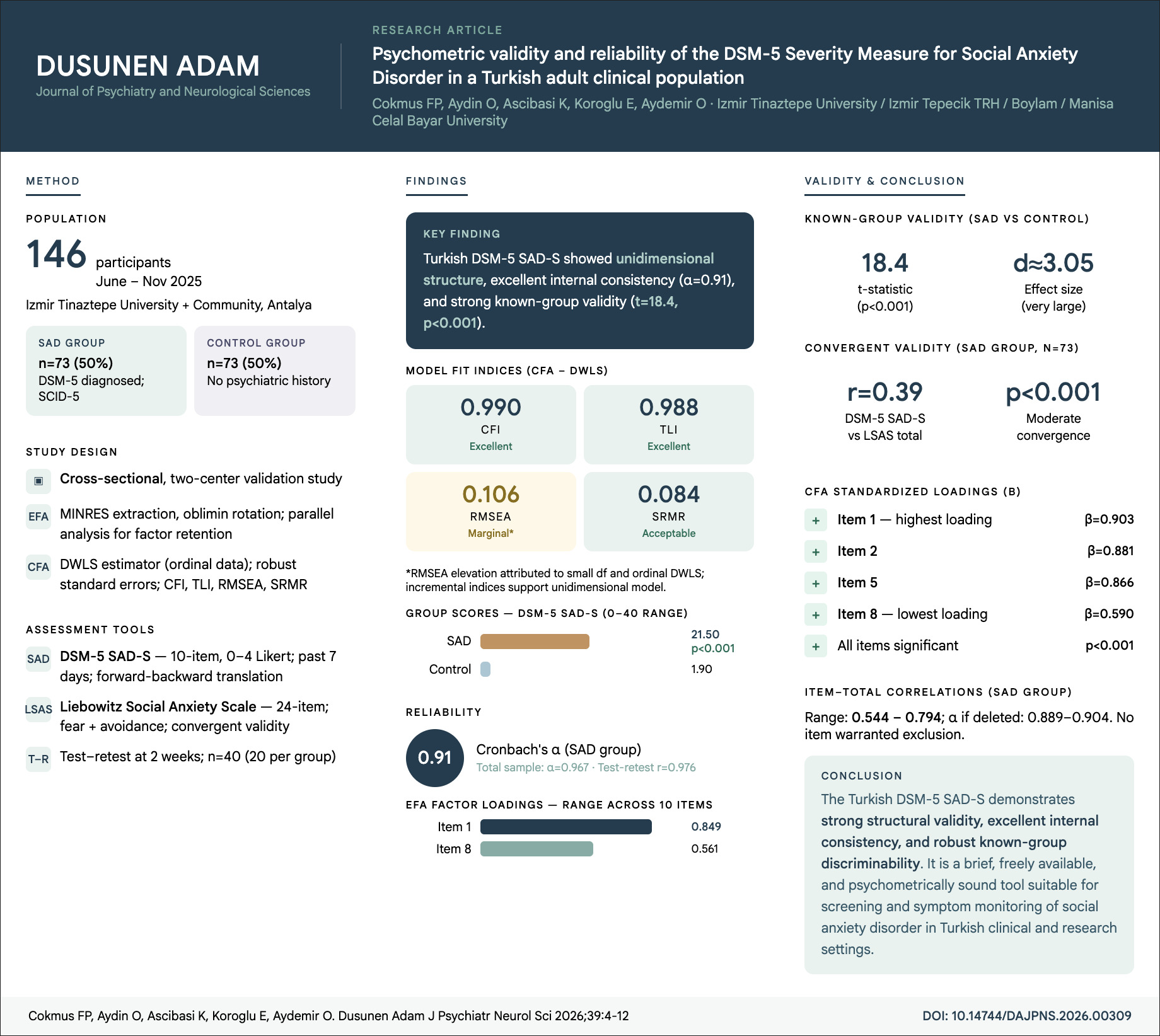
Objective: This study aimed to examine the psychometric properties of the Diagnostic and Statistical Manual of Mental Disorders, Fifth Edition (DSM-5) Severity Measure for Social Anxiety Disorder—Adult (DSM-5 SAD-S) in a Turkish-speaking clinical population. Specifically, we assessed its factorial structure, internal consistency, and convergent and known-group validity.
Methods: The sample included 146 participants (73 diagnosed with social anxiety disorder and 73 healthy controls). All participants completed the DSM-5 SAD-S and the Liebowitz Social Anxiety Scale (LSAS). Exploratory factor analysis (EFA) was conducted using minimum residual extraction with oblimin rotation. Confirmatory factor analysis (CFA), using diagonally weighted least squares (DWLS) estimation, was performed to evaluate model fit. Internal consistency was assessed using Cronbach’s alpha. Convergent validity was examined through Pearson correlation with LSAS scores. Known-group validity was evaluated using the Mann–Whitney U test.
Results: EFA supported a unidimensional structure with strong factor loadings (0.561–0.849). CFA indicated acceptable model fit (Comparative Fit Index [CFI]=0.990; Tucker–Lewis Index [TLI]=0.988; Root Mean Square Error of Approximation [RMSEA]=0.106; Standardized Root Mean Square Residual [SRMR]=0.084). Internal consistency was high (α=0.91). The DSM-5 SAD-S score showed a moderate and statistically significant correlation with the LSAS total score (r=0.39, p<0.001). Patients scored significantly higher than controls (t=18.4, p<0.001), supporting known-group validity.
Conclusion: The Turkish adult version of the DSM-5 SAD-S demonstrates strong psychometric properties and is suitable for use in both clinical practice and research to assess the severity of social anxiety symptoms.
Graphical Abstract