2Tekirdag Namik Kemal University, Department of Psychiatry, Tekirdag, Turkiye
Abstract
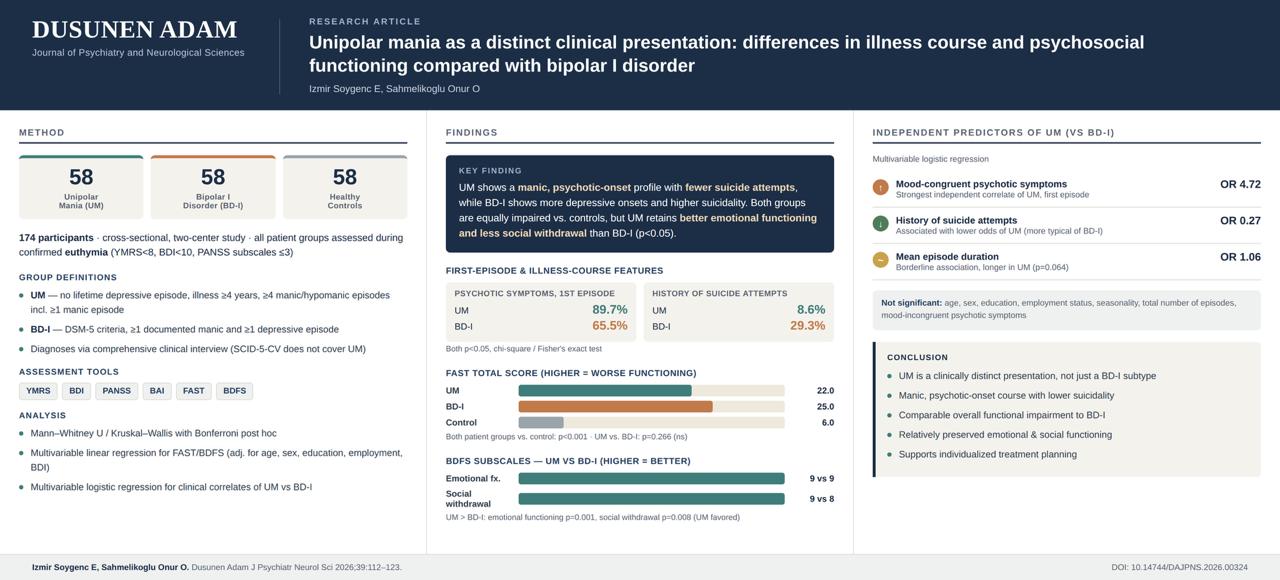
Objective: Growing evidence suggests that unipolar mania (UM) may represent a distinct clinical condition rather than a subtype of bipolar disorder (BD). The present study aimed to compare the sociodemographic characteristics, clinical features, and psychosocial functioning of euthymic patients with UM or bipolar I disorder (BD-I) and healthy control subjects.
Methods: This cross-sectional study included euthymic patients with UM (n=58), BD-I (n=58), and healthy control subjects (n=58). Diagnoses were established according to the Diagnostic and Statistical Manual of Mental Disorders, Fifth Edition (DSM-5) criteria, and euthymia was confirmed using the Young Mania Rating Scale, Beck Depression Inventory, and Positive and Negative Syndrome Scale. Psychosocial functioning was assessed using the Functioning Assessment Short Test (FAST) in all groups and the Bipolar Disorder Functioning Scale (BDFS) in the UM and BD-I groups. Sociodemographic and clinical data were collected using a structured form. Group comparisons were conducted using appropriate parametric and nonparametric statistical analyses.
Results: Both patient groups demonstrated significantly impaired psychosocial functioning compared with healthy controls across all FAST subdomains (p<0.05). On the BDFS, patients with UM showed better emotional functioning and less social withdrawal than patients with BD-I (p<0.05); however, total functioning scores did not differ significantly between groups (p>0.05). Clinically, UM was characterized by manic-predominant onset, higher rates of mood-congruent psychotic symptoms, longer episode duration, and more frequent hospitalizations. Suicidal behavior and total number of mood episodes were higher among patients with BD-I (p<0.05). In the final logistic regression model, mood-congruent psychotic symptoms during the first episode were independently associated with UM relative to BD-I, whereas a history of suicide attempts was associated with lower odds of UM (p<0.05).
Conclusion: Although both groups exhibited functional impairment, patients with UM demonstrated relatively better emotional and social functioning than those with BD-I. These findings suggest that UM may be associated with a distinct functional profile, with potential implications for prognosis and treatment planning. Incorporating functional outcomes into the clinical assessment of UM may help optimize therapeutic strategies and improve long-term psychosocial outcomes.
Graphical Abstract